There is a lot of talk about agriculture in Africa. And rightly so: agriculture affects almost everything. It affects food sovereignty (the ability to feed one’s population by one’s own means), employment, social stability, and even peace and security. Yet despite major political commitments — from Maputo to Malabo, and now Kampala — the results have not lived up to expectations. Regular assessments by the Comprehensive Africa Agriculture Development Programme (CAADP) show that most countries are not on track, nor are they progressing at the pace necessary to achieve their agricultural and food objectives.
With the Kampala Declaration (2026–2035), one thing becomes clear: the problem is no longer that Africa lacks plans. The problem is that many countries are struggling to translate these plans into concrete and sustainable results for producers and citizens. That is why STRATEGIES! advocates a central idea: there will be no sustainable transformation of agri-food systems without functional states, states that are capable of making clear decisions, arbitrating, coordinating actors, and being accountable.[2]
Functional agri-food systems: the strategic ambition
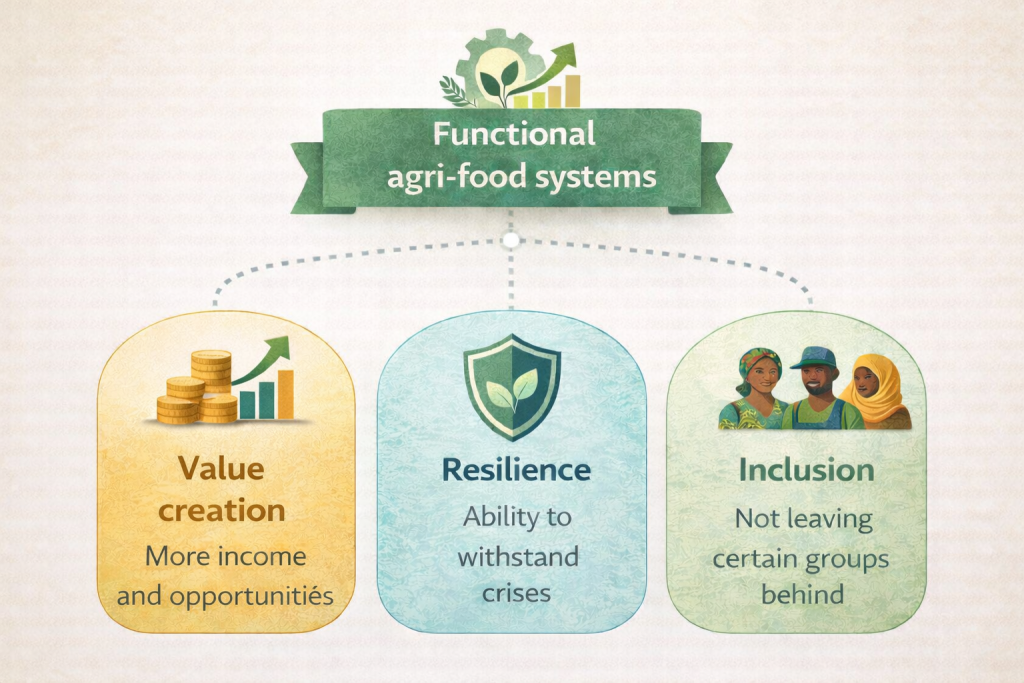
Functional agri-food systems not only produce more, they also enable the following over time:
- Create value (more income and opportunities)
- Resilience (ability to withstand crises: climate, prices, conflicts, instability),
- And be inclusive (not leaving certain groups and territories behind).
These systems can be summarised in three pillars:
- Presence and effectiveness: the State and its services must truly reach villages, communities and producers. There must be no “dead zones” where public action never reaches.
- Security and sustainability: policies must protect essential rights – the right to food, the right to access land, the right to a decent income – while protecting natural resources (soil, water, forests).
- Hope and adaptability: a system that knows how to learn and improve. It recognises its mistakes, adapts to shocks, and builds solutions for the future with actors on the ground.
These systems cannot be built through rhetoric alone. They rely on the coordinated action of what we call the architects of transformation:
- A strategic and arbitrating State that sets the course, makes decisions and coordinates;
- A private sector that creates wealth for all, not just “easy” rents and profits captured by a few: This private sector includes small producers, national SMEs and large multinationals;
- An independent civil society that monitors, explains, alerts and defends the public interest. It includes structured, solid and credible farmers’ organisations, as well as groups representing all other stakeholders in the value chain.
Kampala provides a new continental framework. The real question now is: how can an African state become truly functional to make all this possible? Ten levers, already visible in several African countries, show the way forward.

1. Choose a few priorities, but take political responsibility for them
A functional state accepts a simple truth: you cannot do everything at once. It chooses 5 to 7 strategic sectors using criteria such as nutrition, competitive advantage in the market, industrial development, job creation, etc., and puts all its resources into ensuring the success of these sectors over several years: roads, energy, research, supervision, market policies. One of the reasons for the failure of Maputo is dispersion: many objectives, but too few priorities that are actually pursued.
Example: the Crop Intensification Programme (CIP) in Rwanda. Since 2007, Rwanda has targeted a limited number of strategic crops (maize, wheat, rice, beans, potatoes, cassava). Studies show that in some districts, maize production has increased significantly thanks to a simple combination of inputs, technical support and market organisation. There are debates about its limitations (pressure on traditional crop , risks if these sectors are hit by a shock), but this example clearly shows the strength of a priority that has been pursued for 10 to 15 years.[4][5][6]
Kampala implication: each country must choose a small number of sectors in which to achieve sovereignty, in order to feed the country, and competitiveness, in order to export and earn foreign currency. It must communicate the strategic reasons for these choices to all stakeholders and align budgets, infrastructure and trade with these choices in a sustainable manner.
—
2. Getting public money to producers
Many agricultural plans fail for one simple reason: public money does not reach the fields and producers. The problem is not only “how much we spend”, but “for whom” and “how far” the money actually goes.
Example: digitalised subsidies (e-vouchers/e-wallets).
- An e-voucher is an electronic voucher: instead of a paper voucher or an intermediary, the producer receives a voucher on a digital system.
- An e-wallet is an electronic wallet: producers receive aid directly via their mobile phone or mobile “account”.
In Nigeria, the e-wallet system was designed to avoid “ghost farmers” and false beneficiaries. A subsidy for fertilisers and seeds is transferred directly to producers via mobile phone. In Togo, mechanisms inspired by these approaches have improved traceability and reduced political intermediation.
Implication for Kampala: subsidies must go through traceable channels (mobile money, electronic cards), and lists of beneficiaries must be published so that they can be audited by civil society. The real question becomes: “Did the money actually reach the identified producers?”
—
3. Facilitating access to credit by sharing risk
Banks lend little to agriculture because they consider it too risky: climate, unstable prices, lack of guarantees. Without public action, agricultural credit remains marginal.[11]
Example: the Agricultural Financing Incentive Mechanism (MIFA) in Togo.
“De-risking” so that banks agree to lend. MIFA is based on three ideas: better organising producers, better structuring value chains, and sharing a significant part of the risk with the State through a partial guarantee. This has led to an increase in agricultural credit.[9][10]
Implication for Kampala: rather than small, isolated public programmes, governments must work with existing financial institutions and producers to build risk-sharing mechanisms: guarantees, guarantee funds, index-based insurance (rain, drought, etc.).
—
4. Securing access to land without exclusion
If producers are unsure of keeping their land, they invest less in the long term (trees, irrigation, soil conservation). But beware: some mechanisms can also encourage land grabbing.[12]
Example: Rural Land Plans (PFR) in Benin. The PFR sought to secure existing rights by recognising customary rights, mapping and registering rights with communities. Evaluations show a reduction in conflicts and improved perceived security, with lower costs than a generalised individual land registry.[13][14]
Kampala implication: it is not just a matter of “giving titles”, but of securing existing rights (including collective and customary rights), explicitly protecting women, young people and vulnerable groups.
—
5. Making agricultural services truly useful
Agricultural advice (extension/outreach) can boost productivity. But too often, it is limited to promoting inputs, without supporting the economic management of the farm.
Example: organic cotton in Mali. Programmes (Helvetas and CMDT) have shown that advice focused on agroecology (compost, crop rotation, biopesticides) can significantly reduce input costs and open up higher-value markets. The result: better net margins, because less is spent and more is sold.[16]
Kampala implication: States must modernise extension services: agroecology, economic management, information on prices/weather/risks, via field agents, radio and mobile phones.
—
6. Linking agriculture and children’s nutrition
School canteens, hospitals and the army spend a lot. Directing their purchases towards local producers helps to structure supply chains and guarantee a stable income for producers, which increases their propensity to invest. Food security improves overall.
Example: “Home-grown School Feeding” in Senegal.
An ex-ante study using LEWIE models (models that measure the impact of a programme on the local economy) shows significant potential: stimulation of local economies, increased incomes, better nutrition, provided that payments are reliable and producers are well organised.[17]
Implication for Kampala: integrate the purchase of local food products into the management of all government structures. It is important to set purchase quotas targeting local marginalised groups (women, young people, people with disabilities, etc.), simplify purchasing and payment procedures, and ensure prompt and regular payments.
—
7. Reduce post-harvest losses before producing more
There is a lot of talk about producing more. But a significant proportion is lost or sold too quickly at low prices due to a lack of storage and processing facilities.
Example: farmer warrantage in Burkina Faso.
Warrantage is a simple system: producers store part of their harvest in a secure warehouse and obtain credit with this stock as collateral. This avoids “distress selling” immediately after harvest, allows them to sell later at a better price, and provides cash flow during the lean season.[18][19][20][21][22]
Kampala Implication: invest in local storage, preservation and processing. This must be linked to appropriate and innovative financing such as stock-backed credit. To build producer confidence and encourage them to use intensified production methods, it is important to reduce post-harvest losses and increase their incomes.
—
8. Involve farmers in decision-making
When producers are not genuinely involved, policies fail. In many countries, participation is merely a formality. It is often superficial and/or belated.
Example: the CNCR and LOASP in Senegal. The National Council for Rural Consultation and Cooperation (CNCR) was not only consulted: it proposed, debated, mobilised and ensured that family farming was at the heart of the Agro-Sylvo-Pastoral Orientation Law (LOASP).[25]
Kampala implication: move from simple consultation to genuine co-decision-making, guaranteeing farmers’ organisations a formal place in national agricultural policy steering bodies, financing their capacity for analysis, budget monitoring and advocacy, and ensuring diverse representation (women, young people, livestock farmers, small producers).
—
9. Measure, publish and correct quickly
Maputo and Malabo did not fail because of a lack of objectives, but because of a lack of monitoring and correction. A functional state is not perfect: it knows how to see its mistakes and adjust accordingly.[26][1]
Example: the Harmonised Framework in the Sahel.
This is a common tool (used by several countries) for classifying the severity of food insecurity using shared rules. It produces maps twice a year, which are used to guide responses. It changes the debate: we no longer talk only about “tonnes produced”, but about the populations actually in crisis.[27]
Implication for Kampala: choose a few outcome indicators (food security, median rural income, resilience, pressure on resources), publish annually, and organise an adjustment dialogue that leads to co-decision-making and resource allocation for corrective actions.
—
10. Set up a dedicated implementation team
Agriculture depends on many sectors. Without strong coordination, everything remains on paper.
Example: the ATA in Ethiopia.
The ATA (Agricultural Transformation Agency) is an agency attached to the highest level of government, , created to unblock the implementation of agricultural priorities. It has played a key role in seeds, extension, and processing hubs.
Kampala’s involvement: to create a lightweight unit, integrating key institutions, with a strong political mandate, access to the highest levels of government, and solid analytical, decision-making and efficient implementation capabilities.
—
Conclusion
The Kampala Declaration will not succeed through rhetoric alone. It will succeed if, in each country, the state becomes truly functional: choosing, delivering resources to the last kilometre, engaging in dialogue with all stakeholders, measuring honestly and correcting in real time.[31][32]
The examples of Rwanda (CIP), Togo (MIFA), Benin (PFR), Mali (organic cotton), Senegal (PNASE and CNCR), Burkina Faso (warrantage), the Sahel (Harmonised Framework) and Ethiopia (ATA) show that solutions already exist in Africa: they need to be scaled up, adapted and consolidated.[4][9][13][16][17][18][25][27][28]
The challenge in Kampala is therefore not to produce a new generation of promises, but to move African agriculture from rhetoric to results.
The real question then becomes: how will each stakeholder – the state, farmers’ organisations, the private sector, civil society – respond to these levers?
This is the subject of the second article in this series, which focuses on the key issues that each stakeholder will have to address from 2026 onwards if Kampala is to mark a real turning point.
—
References
[1] https://au.int/sites/default/files/documents/41573-doc-ENGLISH_3rd_CAADP_Biennial_Review_Report_final.pdf
[2] https://africanclimatewire.org/2025/01/african-agriculture-development-strategy-lagging-behind/
[3] https://akademiya2063.org/publications/resakss/EN/ATOR/Complying%20with%20the%2 0Maputo%20Declaration%20Target_2012_ENG.pdf
[4] http://www.irdp.rw/wp-content/uploads/2019/02/Final-printed-CIP-report.pdf
[5] https://www.eajournals.org/wp-content/uploads/Effect-of-Crop-Intensification-Program-on-Maize-Production-in-Nyagatare-Rwanda.pdf
[6] https://tenuresecurity.org/wp-content/uploads/2016/09/USAID_Land_Tenure_Rwanda_Report_Crop_Intensification.pdf
[7] https://openknowledge.fao.org/items/79047b58-7169-4890-b84d-9a569bb6afec
[8] https://www.cbn.gov.ng/OUT/2011/PUBLICATIONS/REPORTS/DFD/BRIEF%20ON%20NIRSAL.PDF
[9] https://www.fondazioneaurora.org/en/tgo-3/
[10] https://www.jeuneafrique.com/mag/1094334/economie-entreprises/avec-le-mifa-le-togo-a-t-il-enfin-trouve-la-cle-du-financement-de-lagriculture/
[11] https://globalagriculturalproductivity.org/wp-content/uploads/2024/07/Public-Expenditure-and-Ag-Productivity-in-Africa.pdf
[12] https://land.igad.int/index.php/documents-1/countries/ethiopia/rural-development-1/358-the-impact-of-ethiopian-land-certification-on-land-conservation-maintenance-and-tree-planting/file
[13] https://catalog.ihsn.org/index.php/catalog/6493
[14] https://pole-foncier.fr/wp-content/uploads/2020/12/9Edja-Le-Meur.pdf
[15] https://www.ijtsrd.com/papers/ijtsrd76235.pdf
[16] https://www.helvetas.org/en/switzerland/what-we-do/our-topics/skills-jobs-income/private-sector-development/economy-expert/organic-cotton-experiences
[17] https://openknowledge.fao.org/bitstreams/d10baaa4-50ab-4a94-af92-5bc3a13dc89b/download
[18] https://reliefweb.int/report/burkina-faso/warrantage-paysan-au-burkina-faso-acc-s-au-cr-dit-par-le-biais-des-stocks-de
[19] https://www.oxfam.org/en/research/smallholder-warrantage-burkina-faso
[20] https://www.fao.org/4/aq217f/aq217f.pdf
[21] https://www.fao.org/family-farming/detail/fr/c/1642925/
[22] https://revue-sesame-inrae.fr/burkina-faso-leffet-insoupconne-du-stockage-de-cereales/
[23] https://acetforafrica.org/research-and-analysis/insights-ideas/articles/smallholder-farmer-voices-challenges-and-opportunities/
[24] https://www.linkedin.com/pulse/agriculture-policies-strategies-implementation-africa-nyoni-phd
[25] https://www.alimenterre.org/system/files/ressources/pdf/87_participation_des_op_aux_politiques.pdf
[26] https://www.shareweb.ch/site/Agriculture-and-Food- Security/news/Documents/2018_05_28_au_report_malabo_declaration_summary.pdf
[27] https://agrhymet.cilss.int/wp-content/uploads/2023/07/Manuel-CH-2.0_Fr_VF.pdf
[28] https://openknowledge.fao.org/server/api/core/bitstreams/8d6f503a-fbc8-461c-905b-a7e370d81033/content
[29] https://www.ifpri.org/blog/ifpri-book-improving-african-agricultural-value-chains-boost-production/
[30] https://www.solidaridadnetwork.org/publications/african-governments-fail-smallholders-in-their-commitments-made-in-the-malabo-declaration/
[31] https://african.business/2025/02/resources/africa-has-a-bold-plan-for-agriculture-now-is-the-time-to-implement-it
[32] https://agra.org/wp-content/uploads/2020/08/AGRA-WhitePaper-State-Capability.pdf