Passing laws and budgets is not enough to transform public action
A Parliament may approve an ambitious health budget. The government may report having spent most of the allocated funds. Yet medicines remain in short supply, equipment is still unusable, and people continue to face the same barriers to healthcare.
Where does public-sector performance lie: in the budget approved, the money spent, or the services actually delivered to citizens?
This question extends beyond healthcare. In many countries, infrastructure projects are budgeted for but never completed. Agricultural policies receive funding without adequately reaching farmers. Audit reports document persistent shortcomings without prompting the necessary corrective action.
The gap between decisions made, resources mobilised and results achieved lies at the heart of the question of State functionality.
Since 2020, STRATEGIES! has championed a central conviction: Africa’s development depends on its ability to build Functional States. A Functional State has several components. A Functional Parliament is an essential component of a State that functions sustainably.
The Functional State: Beyond the Mere Existence of Institutions
A State does not become functional simply by having institutions, adopting laws or holding elections.
A Functional State has structures and systems capable of sustainably improving people’s well-being, guaranteeing citizens’ rights and protection, expanding their opportunities to thrive, and anticipating risks while adapting to change.
This functionality rests on three complementary dimensions.
Presence and Effectiveness: The State must fulfil its responsibilities throughout its territory and for all population groups. Its presence must translate into accessible, high-quality services. A school without teachers or a health centre without medicines illustrates a presence that does not ensure effectiveness.
Safety and Sustainability: The State must protect rights, ensure citizens’ security, and uphold justice and equity in the operation of its institutions and systems. The long-term sustainability of the State and its institutions depends on respect for fundamental rights, citizens’ perceptions of justice and equity, and accountability to them.
Hope and Adaptability: The State must create genuine prospects for improving living conditions while strengthening its ability to anticipate and manage crises and transformations.
These three dimensions call for moving beyond a view of the State centred on resources mobilised, towards an assessment of its results and its capacity to sustain and improve them while adapting to change.
Parliament: An Essential Link in State Functionality
Parliament does not manage the public administration or implement public policies. These responsibilities fall to the executive and the relevant government departments.
Nevertheless, Parliament occupies a pivotal position in the public-action chain:
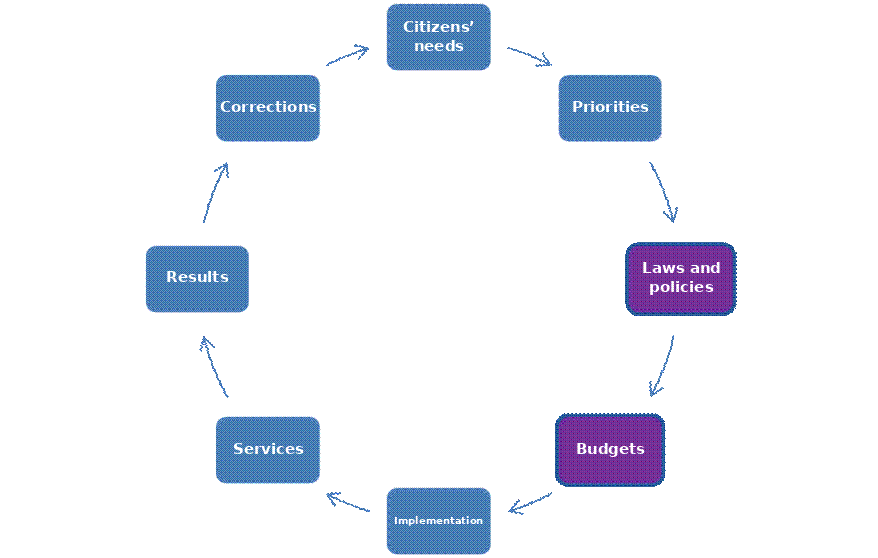
By representing citizens, passing laws, authorising resources and overseeing government action, Parliament enables the State to reach citizens, deliver services in accordance with rights, justice and equity, and not only meet immediate needs but also create hope by preparing for the future and innovating to meet tomorrow’s needs.
Before funds are spent, Parliament can examine whether priorities and allocations are coherent. During implementation, it can request information and identify gaps in the quality and volume of spending. Afterwards, it can draw on evaluations and audits to demand explanations and monitor corrective action, thereby supporting continuous improvement in public expenditure.
Parliament is not responsible for guaranteeing, on its own, the results achieved by the State as a whole. Its responsibility is to help ensure, within its mandate, that public decisions are better justified, implementation is more closely scrutinised, and shortcomings are more effectively addressed.
According to the International Budget Partnership’s Open Budget Survey 2025, sub-Saharan Africa recorded an average score of 44 out of 100 for budget oversight, unchanged since 2023. This indicator assesses the roles of both Parliaments and supreme audit institutions.
National situations nevertheless vary. In Benin, legislative oversight scored 67 out of 100 in 2023, demonstrating that stronger institutional oversight capacity exists on the continent.
The challenge, however, is not to confuse the capacity to exercise oversight with the actual effects of that oversight.
According to Afrobarometer, only 37% of respondents across 39 African countries said they trusted their Parliament in surveys conducted between 2021 and 2023. Across the 30 countries for which comparisons with 2011–2013 were possible, trust had declined by 19 percentage points.
These findings do not directly establish technical shortcomings in parliamentary oversight. They nevertheless highlight the importance of strengthening representation, transparency and accountability.
The Key Elements of Parliamentary Functionality
Within a National Assembly, one body plays a significant role in the annual review of budgets, the organisation of hearings and the oversight of public finances: the Finance Committee, often associated in English-speaking countries with the Public Accounts Committee (PAC). Names vary across countries, but the core function remains the same: carrying out the technical work that helps ensure public spending benefits citizens and improves year after year.
To perform this work, the Finance Committee (FC) itself depends on the three pillars of functionality.
| Dimension of functionality | Description |
| Presence and Effectiveness | The effectiveness of the Finance Committee requires several key factors:
|
| Safety and Sustainability |
To fulfil its role safely, in the national interest and over the long term, the Finance Committee needs the following conditions:
|
| Hope and Adaptability | To ensure continuous improvement in public expenditure, the Finance Committee needs to:
|
From Parliamentary Activity to Contributions to Results
The continuous strengthening of a Functional Parliament draws on the three dimensions of functionality to make a significant contribution to these same dimensions of State functionality as a whole.
A Functional Parliament, and particularly a Functional Finance Committee:
- Strengthens Presence and Effectiveness by checking whether resources reach communities and produce useful services.
- Contributes to Safety and Sustainability by safeguarding rights and the continuity of public action.
- Supports Hope and Adaptability by examining whether policies create opportunities and prepare the State for future challenges.
Africa needs more than Parliaments that pass laws and budgets. It needs Parliaments that check what becomes of those decisions, demand accountability and help make the State more functional.
For there can be no Functional State without a Functional Parliament.
Coming Up in This Series
This article explains why parliamentary functionality is indispensable to State functionality. The second article, “Public Finances: Six Requirements for Truly Effective Parliamentary Oversight”, offers a practical framework for reviewing budgets. The third will explore the changes needed to move from formal oversight to effective corrective action.
References
- International Budget Partnership — Open Budget Survey 2025, Sub-Saharan Africa
- International Budget Partnership — Benin, 2023
- Afrobarometer — Trust in African Institutions, October 2024